Buying guides · 5 June 2025
Choosing your first DJI drone: Mini, Air or Neo?
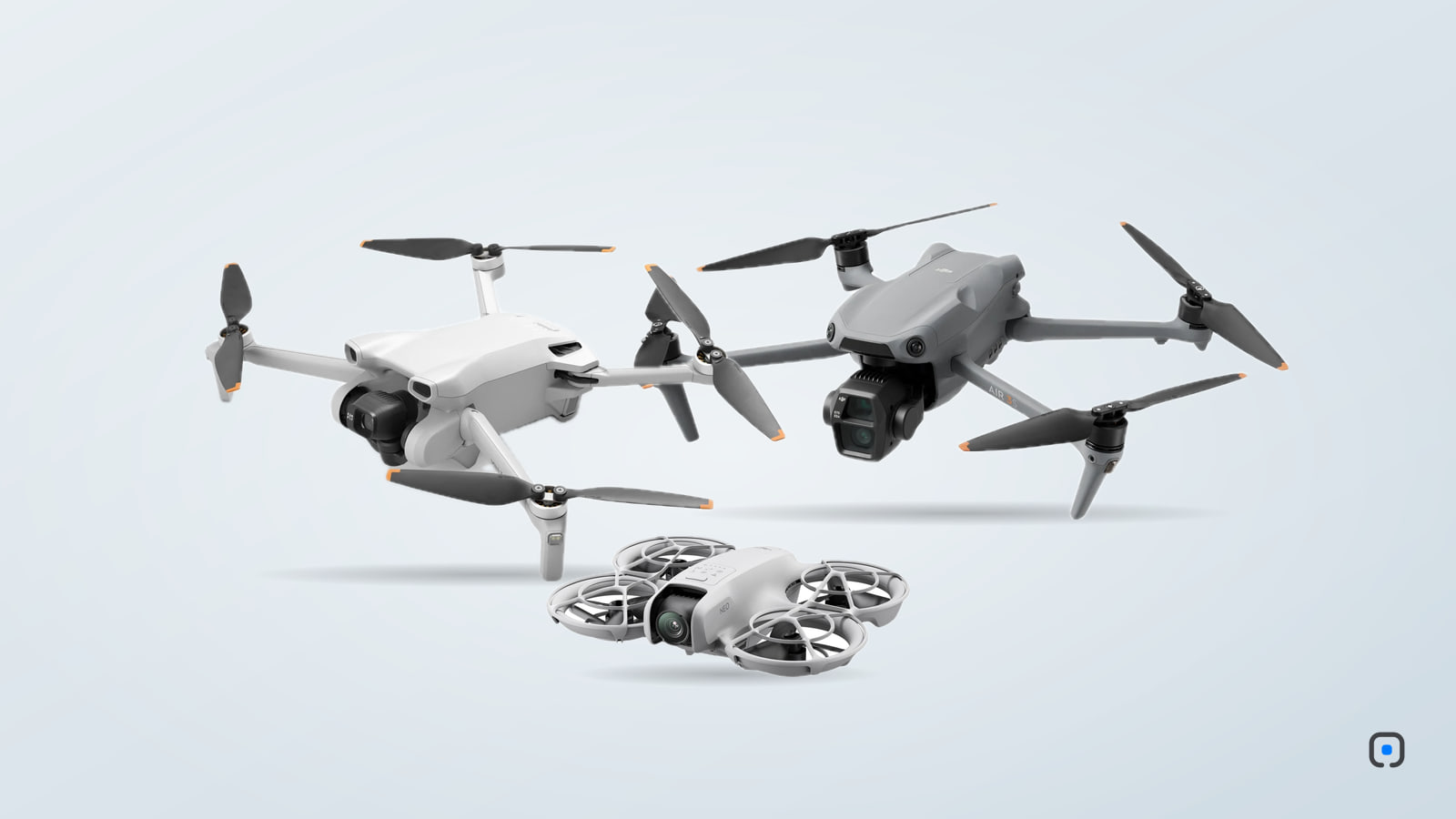
Three DJI drones, three very different first flights. How the Neo, Mini 3 and Air 3S compare, and what Ghana's aviation rules ask of you before take-off.
By iVillage Africa
Picture a Saturday morning at Kokrobite. The tide is out, a friend is walking along the wet sand, and you want the shot from above: the long line of footprints, the surf, the fishing canoes pulled up in a row. A phone cannot give you that. A drone can, and the question is which one.
DJI makes a lot of drones. We carry three that suit a first-time owner very well, and they are more different than their prices suggest. Here is how to choose.
DJI Neo: the one you launch from your palm
The DJI Neo arrived in September 2024 and weighs just 135 grams. You hold it flat on your hand, pick a mode, and it lifts off, films you and comes back to land on your palm. No controller is needed for the basic shots; your phone or the buttons on the drone itself are enough.
It shoots 4K video, and its propellers sit inside full guards, which makes it forgiving when you fly close to people or walls. It is built for short clips of yourself: a dronie pulling away from you at a naming ceremony, a follow shot on a bicycle, an orbit around a group of friends.
What it is not built for is distance or wind. Flights are short, and on a gusty afternoon by the sea a drone this light will struggle. Think of the Neo as a flying camera for moments, not for landscapes.
DJI Mini 3: the sensible all-rounder
The DJI Mini 3 was announced in December 2022 and is still the drone we would hand to most beginners. It weighs under 249 grams, comes with a proper controller, and stays in the air for up to 38 minutes on a battery.
That flight time changes how you fly. With the Neo you rush. With the Mini 3 you can climb, look around, take your time composing the shot of Jamestown lighthouse, and still have battery left to bring it home calmly. It records 4K HDR video, and its camera can rotate for true vertical shots, useful if most of what you film ends up on Instagram or WhatsApp Status.
The trade-off is obstacle sensing. The Mini 3 relies on you, not sensors, to avoid trees and poles, so learn in an open field before you fly anywhere tight.
DJI Air 3S: for people who already know they love this
The DJI Air 3S launched in October 2024 and is a real step up. It carries two cameras: a main one with a 1-inch sensor and a 70mm medium telephoto. The larger sensor holds far more detail at dusk, when Accra's skyline turns orange and the street lights come on. The telephoto lets you stay back and still fill the frame.
It has omnidirectional obstacle sensing, flies for up to 45 minutes and is heavier and steadier in wind. For someone filming property, events or travel with a serious eye, it is the one that will not leave you wanting more after six months.
For a complete beginner it can be too much drone. If you are not sure you will keep flying, start smaller.
DJI also makes the Avata line of FPV drones, flown with goggles for fast, immersive flight. They are wonderful and quite a different hobby; we do not stock them.
A simple way to decide
- Mostly filming yourself and friends, short clips, easy to carry: Neo.
- Learning to fly properly, landscapes and events, best balance: Mini 3.
- Low light, telephoto shots, paid work or serious travel: Air 3S.
Flying legally in Ghana
This part matters more than the camera. Drones in Ghana are regulated by the Ghana Civil Aviation Authority (GCAA), which calls them Remotely Piloted Aircraft Systems, or RPAS. Light weight does not exempt you here the way it can in some countries.
According to the GCAA's own guidance:
- Register the drone with the GCAA. Registration is done through the Authority, with first registration handled at its offices near Kotoka International Airport, and it has to be renewed.
- Commercial work needs more. If you are paid to fly, whether for a wedding, a real-estate listing or a survey, you need an RPAS Operator Certificate on top of registration.
- Stay away from airports. Do not fly near Kotoka or any other airfield without GCAA approval. The Authority's rules set exclusion buffers of several kilometres around airports and helipads.
- Respect restricted areas. Military sites, government buildings and other security areas are off limits, and so is flying over crowds.
- Keep your distance from people and property and keep the drone in sight. Night flying needs special permission.
The GCAA publishes its RPAS FAQs and registration process on its website, and it is worth reading the current version before your first flight, because fees and procedures are updated from time to time. DJI's app will also show geofenced zones, but treat that as a reminder, not as permission.
One practical note: much of central Accra sits close to Kotoka's approach paths. A beach or a farm outside the city is a better, calmer place to learn anyway.
After you buy
Every drone we sell is brand-new and sealed, and carries DJI's manufacturer's warranty. If something goes wrong, we help you make the claim with DJI.
Whichever you choose, charge every battery the night before and spend your first flight in an empty field; the beach shot will still be there next Saturday.
Comments
No comments yet — be the first.
Sign in to join the conversation. You can comment under your name or anonymously.